Dawn of the Planet of the Apes isn't just the pinnacle of a new type of acting...it just might be the beginning of a better type of blockbuster.
In 2008's The Dark Knight, Harvey Dent walks up to a podium in broad daylight in front of a crowd of angry and scared Gothamites. He does so in the hopes of quelling the fears of a city on the verge of a mental breakdown. But even though his demeanor remains calm, the citizens of Gotham do not. They interrupt and plead for him to give in to the demands of a psychotic criminal before things get even worse. And who can blame them? The Joker is terrorizing their city in a way that's never been seen before, either by them or by us in the audience. Eventually, even Harvey has to admit that they've reached a new low. But in this admittance, he reassures everyone that just because it's bad now doesn't mean it can't get better. "The night is darkest just before the dawn," he declares. "I promise you, the dawn is coming."
Well Harvey, the Dawn is here. And it is beautiful.
Dawn of the Planet of the Apes is a sequel to a prequel that rebooted a 46-year old franchise. Its very existence as a movie seems preposterous. That type of connectivity to past movies screams out that Hollywood is just trying to make a buck. But DotPotA (even in acronym form it seems ridiculous!) is so much more than a prequel-sequel-reboot. It continues Rise of the Planet of the Apes' CGI facelift of the 1968 original in all the right ways. It isn't a perfect movie. But it is the best movie you may see this summer.
What makes DotPotA so good? The dedication and confidence in its intelligent story, its complex characters, its CGI wizardry, and its simian-like actors. It would have been easy for director Matt Reeves (Let Me In, Cloverfield) to joke at the absurdity of apes riding on horseback or rebelling with machine guns, but the tone remains serious throughout. The movie deals with themes of war, rebellion, and family as if its giving a lecture on current world politics. Who knew a movie about talking apes could be so profound? This seriousness continues as trust between the humans and apes is built up and destroyed seemingly every 15 minutes, and often in startling ways.
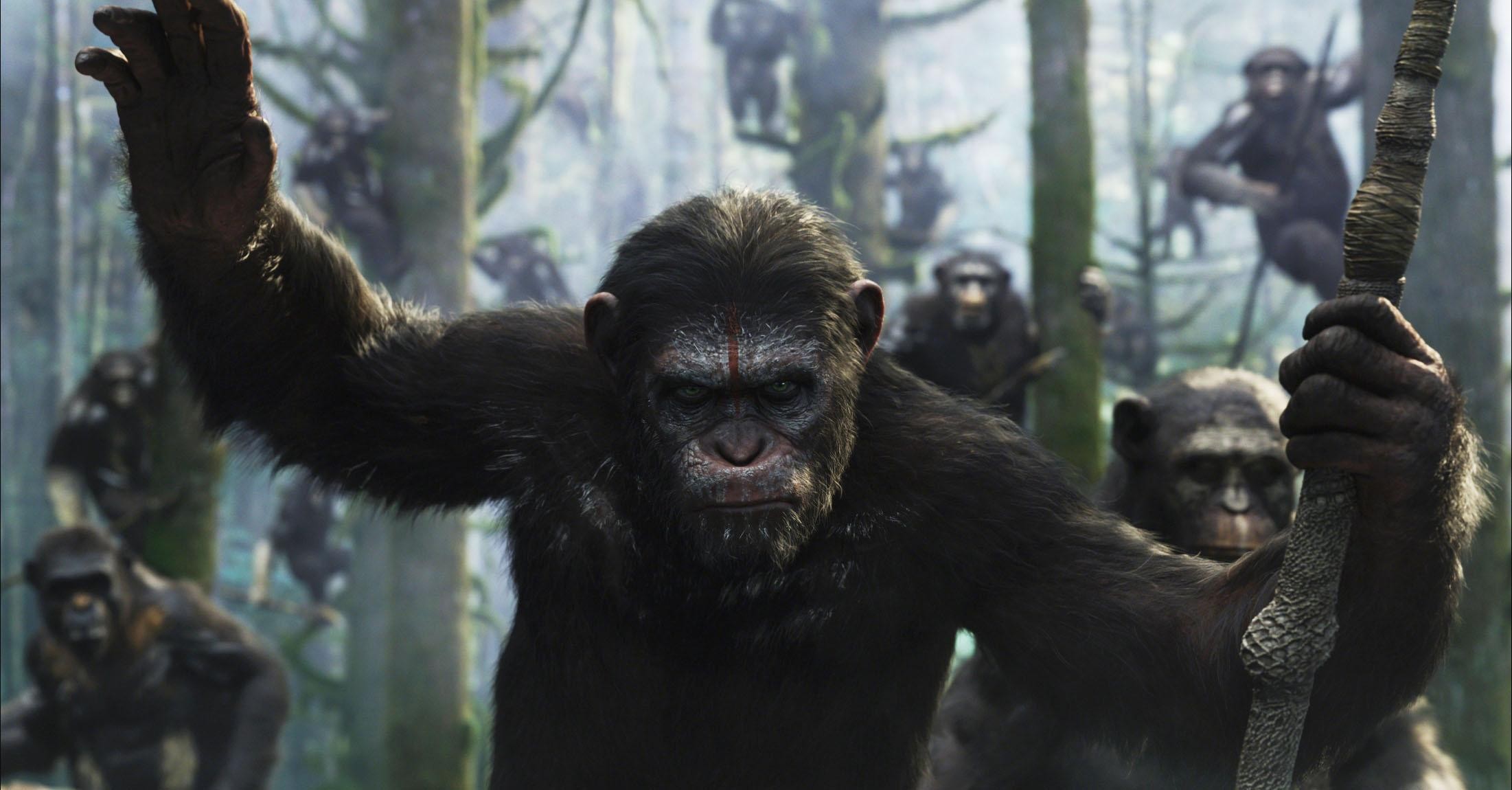
Like it's predecessor, Dawn also never suffers from a lack of stylized directing. There are silent scenes that rely on the actors and the spectacular CGI visuals alone, including a prolonged opening scene featuring Caesar's ape tribe (a clear nod to the opening of 2001: A Space Odyssey, except these apes don't need a monolith to boost their intelligence...they already know how to use sign language, much less use weapons). There's a great 360 degree shot on top of a tank that captures both the ape takeover of the vehicle and the scale of the surrounding battle. And there's a battle scene between two apes that is at once reminiscent of the construction chase in Casino Royale, yet explores the completely new possibilities of how apes can use their surroundings in a fight in more effective ways than humans.
But the real revelation here, as it also was in Rise, comes from the motion capture acting. Great movies allow the audience to suspend their disbelief, and in a movie about intelligent apes fighting a war against Earth's last human survivors, that's a pretty big thing to ask. Yet through the work of multiple actors committed to monkeying around in motion capture suits--along with the brilliant work from Weta Digital (Avatar) to turn these human actors into hulking apes--the audience believes in this world fully, from the opening shot of Caesar's green speckled eyes to the closing one.
While all the critical attention has been given to Andy Serkis (who played Caesar as both a young and old ape in Rise, and also famously played Gollum in The Lord of the Rings and King Kong in...well, you know), special praise here should also be given to Toby Kebbell, who plays the terrifying Koba. I'm one of the many people who believe Serkis should have at least one Oscar nomination by now, but if a nomination is going to be given out to anyone in this movie, it should be Kebbell that gets the nod over Serkis (though give Serkis credit for allowing his supporting cast to shine...after all, motion capture is his baby. He didn't have to start a school to help others reach his level.)
In the ape tribe, Koba is the Scar to Caesar's Mufasa. He's a loose cannon that is more trusted than he deserves to be, and Kebbell plays it perfectly. Koba's face is scary enough with his one foggy eye and multiple lacerations, but it is Kebbell's acting that gives Koba a lunacy which is impossible to anticipate. One scene in particular, where Koba confronts two humans testing machine guns on the waterfront, is so sadistically played that it made people in my theater laugh with delight and scream in terror within moments. I hadn't heard a theater react like that since seeing Heath Ledger's turn as the Joker.
Which brings me back to that opening paragraph. Though Harvey's quote is a simple analogy to compare the end of a dark night to the current situation in Gotham, it might as well be comparing that same dark night to the current situation of the summer blockbuster. A smart summer blockbuster is a rare occurrence. Outside of the works of Christopher Nolan, we hardly ever see smart summer movies that make boatloads of money anymore. Studios want their summer movies to play to the widest audience possible, and making movies that would go over the heads of some of that audience means lost profits. So, we get dumbed down movies like Tammy, Think Like a Man Too, and Transformers: Age of Extinction.
Dawn is literally arriving after the darkest point of the summer, where a movie that received a 17% rating on Rottentomatoes became critic proof and still took in over $600 million worldwide. We as a movie-going public should not want this to happen. No one needs to support Michael Bay. It's movies like Dawn that deserve our support.
If Dawn of the Planet of the Apes makes money, it will once again show that big, smart movies are still worth making, just as Rise of the Planet of the Apes did when it proved to be far more intelligent and successful than anyone thought it had any right to be, and as The Dark Knight did when it blew away our notions of whip-smart filmmaking in 2008. This weekend will hopefully end with Dawn taking its rightful place at the top of the box office. And maybe, just maybe, it will even show Hollywood that someone other than Nolan can direct a sequel that will make money AND be made with the care, concern, and intellect that the audience deserves.
The dark night is over, ladies and gentlemen. The Dawn is here. Go and gaze upon its beauty.

No comments:
Post a Comment